Background
Europe’s energy system is undergoing a profound transformation. As renewable energy sources increasingly replace conventional generation, power grids are becoming dominated by power-electronics-based technologies such as HVDC links, offshore wind connections and advanced converter-based infrastructure.
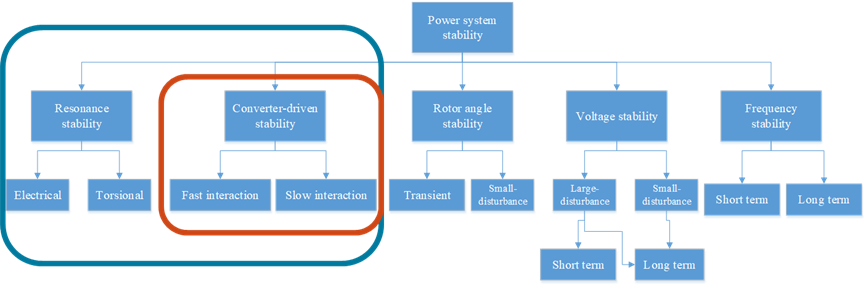
Whilst essential for a decarbonised future, this shift introduces new fast dynamic behaviours, spectral interactions and stability challenges that conventional tools and approaches are not designed to capture. Ensuring the secure operation of future hybrid AC/DC grids relies on having advanced methods to identify, analyse and mitigate converter-driven instabilities and harmonics.
Goals
MITIGATE-HARM was created to address this gap. Building on cutting-edge research, open-source developments and industrial collaboration, the project’s mission is to equip operators and technology providers with the methods and tools needed to ensure stable, resilient and interoperable power-electronic-dominated energy systems.
To turn this into real-world impact, MITIGATE-HARM aims to strengthen and expand two leading open-source platforms, Harmony and DPsim, enabling fast, accurate and user-friendly stability analysis and simulation. All methods and tools are validated with real-world systems and utility data in close collaboration with transmission system operators.


Team
The MITIGATE-HARM consortium brings together leading expertise in power electronics, dynamic system stability, real-time simulation technology and open-source software engineering.
Our team includes 6 partners from 4 European countries: TU Delft, AUTH, RWTH Aachen, TenneT, OPAL-RT and CRESYM.
Together, we unite academia, industry and open-source infrastructure to deliver practical, scalable and future-proof solutions.
Organisation
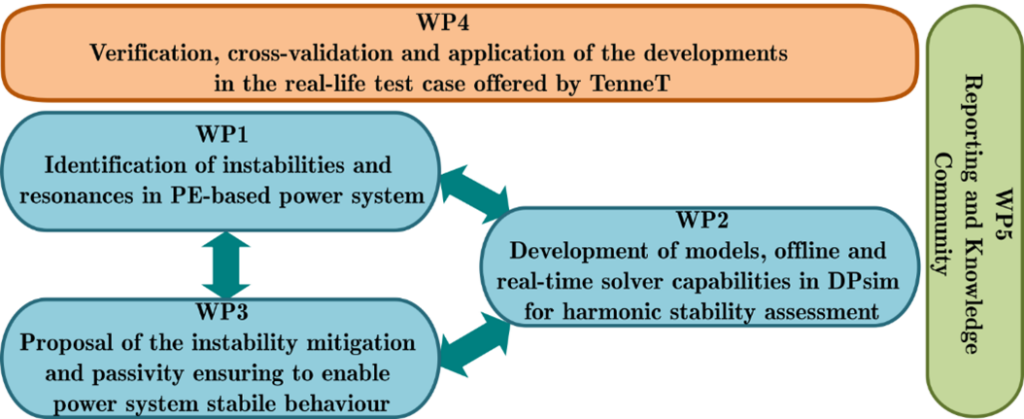
MITIGATE-HARM is organised across five integrated work packages covering research, tool development, validation and community engagement. A strong feedback loop between methodology design, software implementation and real-system testing ensures each innovation is robust and application-ready.
The project is coordinated by TU Delft, with support from CRESYM for communication, dissemination and especially the long-term exploitation of the results by the industry.
Our commitment to open science, international collaboration and transparent development ensures that project outcomes remain accessible, impactful and aligned with European energy-system priorities.